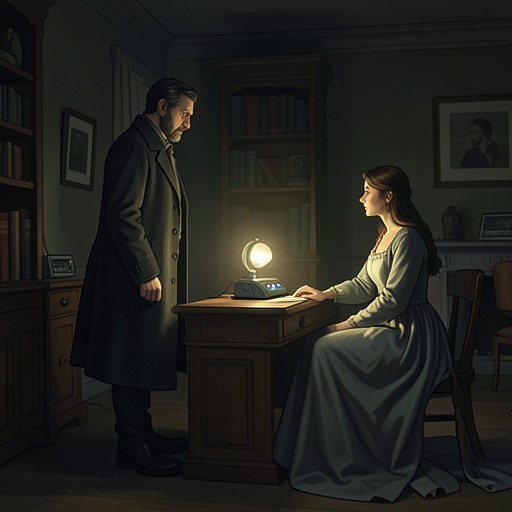
Don Manipulates Zlenko by Invoking a Witchcraft Ritual
Panic RoomDon Challenor’s manipulation of Gennady Zlenko is a sudden act of tactical invention that turns the Fry family’s reputation for witchcraft into immediate leverage. In a car controlled by Jack Harkness, with Amos French and Zlenko also present, Don gives Zlenko a ritual to perform at Tredarvas Farm. Zlenko’s fear overrides French’s objections and changes the car’s destination: the group will return for the supposed means of breaking Wynsum Fry’s power before going on to Wortalleth West. The episode shows how a supernatural claim, whether believed or not, can produce concrete consequences when it meets a frightened listener and an armed man’s authority.
The Fry family and the witchcraft claim
The exchange arises from a conversation about Wynsum Fry. French presses Harkness on why Wynsum believed he had killed her brother, Jory Fry, and asks whether he did it. Harkness refuses to discuss the accusation as though it could alter anything, saying that both Wynsum and Jory are dead. When French asks what made Wynsum a thorn in his side, Harkness describes her as someone who presented herself as a fortune-teller and read cards. Don then identifies her as a real witch. The narration marks the statement as unplanned: after saying it, Don himself does not understand why he spoke.
That uncertainty matters. The scene does not establish that Wynsum possessed supernatural powers, nor does it confirm the truth of the curse Don later describes. Instead, the claim enters a conversation already charged by the history between the Harkness and Fry families. Earlier accounts connect that family hostility to an older generation: Calensa Fry wanted Don to accuse Harkness in print of responsibility for Jory Fry’s drowning, and she traced the feud to the families’ opposing sides in the Cornish rising of 1648. Calensa repeatedly asserted that Harkness had held Jory beneath the water at a rock pool on 1 August 1970, a date she associated with Lammas. These are claims and inherited memories, not an independent resolution of what happened to Jory.
The family’s reputation also rests on practices that can be read in more than one way. Andrew Glasson recounts consulting a seer after Jane Glasson disappeared. He shuffled ordinary playing cards, dealt twelve face down, and watched the seer turn over eleven red hearts or diamonds and one card of another colour. She interpreted the predominance of red as evidence that Jane was alive. Glasson admits that, at the time, he let himself believe her because he longed for certainty. The account presents divination as a practice capable of organizing hope and belief without demonstrating that it can establish the facts it claims to reveal.
Don turns belief into leverage
Zlenko’s response shows that Don’s declaration has landed with force. He asks whether Wynsum really was a witch, then turns to Don for confirmation and demands to know how Don could know. Don says that she cursed him when he refused to do what she wanted. He adds that Zlenko should be careful. Zlenko becomes visibly alarmed, crosses himself, murmurs in Russian, and tells Harkness to stop the car. French insists that they continue to Wortalleth West, but the disagreement has begun to shift control of the journey away from him.
After Zlenko returns to the car and leaves its door open, Don notices the fear in his expression and sees an opportunity. He tells Zlenko that there is a way to neutralize Wynsum’s power: a piece of clothing she wore next to her skin must be taken to the place where she was born. French tries to silence Don, but Zlenko orders him to continue. Don supplies the next step: the clothing must be burned, after which Zlenko will be free of her. The source offers no independent confirmation of this procedure. Its force in the scene comes from Don presenting it as usable knowledge at the moment Zlenko is desperate for a way out of danger.
Don names Tredarvas Farm as Wynsum’s birthplace, describing it as a ruin near Mullion and saying that Harkness knows where it is and can take them there. When Zlenko checks this with Harkness, Harkness confirms that he could take them, though he begins to qualify his answer. Zlenko cuts off the discussion by pressing his demand: they are going back for the clothing. The ritual’s instructions have become an order governing the group’s movement.
The reversal in the car
French objects to the detour and tries to keep the original destination in force. Zlenko refuses. Although he agrees that they will go to Wortalleth West afterward, he insists that they return first to retrieve the supposed object needed for the ritual. When Harkness cautions against going back to Chybargos, Zlenko again demands a change of direction. French threatens Don, promising that Don will regret his intervention, but the threat does not restore French’s control. Under Zlenko’s command, Harkness finally agrees to turn back.
The immediate result is practical rather than supernatural: the car’s route changes because Don has given Zlenko a story he believes, or fears enough to act upon. Zlenko’s weapon and insistence make the change consequential for everyone in the vehicle. Harkness must comply, while French’s objections fail to prevent the reversal. The scene does not show whether the ritual is performed or whether the clothing is found; its established outcome is that the group turns back, postponing its journey to Wortalleth West.
What the episode establishes
Don’s intervention works through an uneasy combination of inherited conflict, personal testimony, and improvised instruction. His brief assertion that Wynsum was a witch gains credibility for Zlenko when Don claims to have been cursed himself. He then converts that credibility into a precise, place-bound remedy involving Tredarvas Farm. The specific steps give fear a direction: rather than remain helpless before an unseen power, Zlenko can act, and he can compel the others to help him do so.
The episode leaves the supernatural question unresolved. Earlier material describes both the Fry family’s divination and Don’s sense that his own susceptibility changed after dealing with them, while also preserving explanations based on psychological influence and the power of belief. Here, the evidence is not proof that Wynsum’s curse exists; it is proof that Don’s account changes Zlenko’s conduct. The reversal makes the story’s distinction between supernatural truth and social effect especially sharp: whatever the unseen powers may be, the fear attached to them is sufficient to redirect a car, override French, and place Harkness under Zlenko’s command.